

University West’s one and only international journal is scaling new heights
23 Oct 2026
Just over a year after its launch, Current Issues in Work-Integrated Learning (CIWIL) is quickly establishing its status as a vital international hub for research bridging the gap between work and learning. The journal focuses on work-integrated learning, which is also one of University West’s areas of strength.
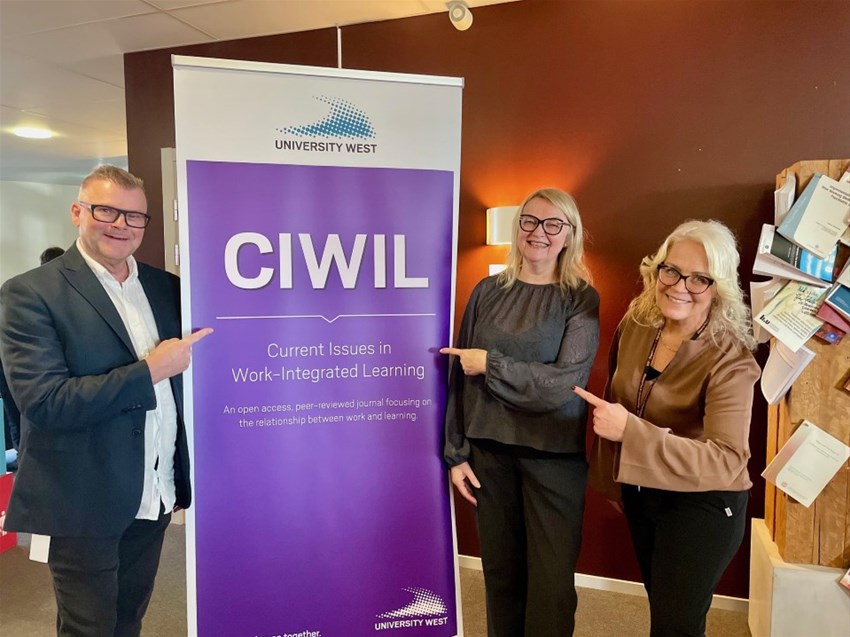
The editorial team at the time of the launch: Professor Per Assmo, Dr Irene Bernhard and Professor Ulrika Lundh Snis.
Published by University West, the open-access, peer-reviewed journal has rapidly evolved into a global platform for high-quality scholarship dedicated to connecting professional practice, educational innovation, and societal development.
Since its inaugural issue in 2025, CIWIL has already published more than 15 scholarly contributions. This diverse collection - spanning empirical studies, conceptual frameworks, reviews, and collaborative research - mirrors the expanding landscape of the WIL field.
Celebrating CIWIL’s Recent Milestones
The journal’s growth is not merely quantitative but also qualitative. As CIWIL continues to define the future of the field, several key developments underscore its rising influence:
- Growing academic recognition: CIWIL has officially been indexed in the Finnish Publication Forum (JUFO) as well as the Norwegian List level 1, which is a significant milestone that further validates the journal’s academic rigor and commitment to scholarly excellence.
- The power of collaboration: A major driver of the journal's recent momentum is the high-quality editorial board that reflects the valuale and global academic network as well as the introduction of guest-edited special issues. By inviting expert guest editors to curate themed collections, CIWIL fosters deep dives into niche and emerging areas of study.
- Democratising access to open science: As a young, dynamic, and accessible journal, CIWIL operates on a continuous-submission model and provides full open access with no publication fees. This helps remove traditional barriers and enables high-quality knowledge to be shared more widely and equitably.