
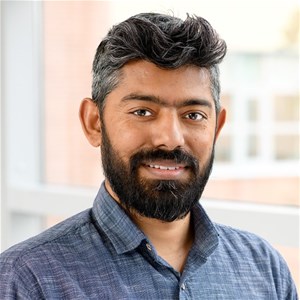
Rashid Ali
Universitetslektor
Wireless Networking and AI
Organisationstillhörighet
Anställd på Avdelningen för Datateknik.About Dr. Rashid Ali
Rashid Ali is currently a Senior Lecturer at the Department of Engineering Science, University West, Sweden. He has a strong academic and industry background, focusing on cutting-edge technologies in wireless networks and artificial intelligence (AI). His research interests include federated learning, reinforcement learning, and their applications in wireless networks, sensors, and intelligent systems.
He actively supervises Ph.D. students in sensors and AI, and participates in industrial-academic collaborations. Rashid also holds a Higher Education Pedagogy Certificate from Gothenburg University, underlining his dedication to quality teaching and student engagement.
He earned his B.S. in Information Technology (2007), followed by M.S. degrees in Computer Science and Informatics from University West. He completed his Ph.D. in Information and Communication Engineering at Yeungnam University, South Korea (2019).
Career Highlights
- WiMAX Engineer – Wateen Telecom, Pakistan
- Lecturer – COMSATS University, Pakistan
- Assistant Professor – Sejong University, South Korea
- Postdoctoral Fellow – Yeungnam University, South Korea
- Marie Sk?odowska-Curie Fellow – Universitat Pompeu Fabra, Spain (2021–2023)
Research Interests
- Federated & Reinforcement Learning
- AI for Wireless Networks & Intelligent Systems
- Indoor Positioning and Wi-Fi Tracking Systems
Research Projects
Dipy-AI (2024–2027)
Funded by KK Foundation/Primus. Focused on DIKW-based AI architecture for sensor data processing in industrial environments. Contacts: Amit Mishra, Rashid Ali, Thomas Pederson, Hakan Karasu
AI-PROWIL (2024–2027)
NSF-funded IRES program for research exchange with RIT USA, focusing on AI-enhanced automation in production. Contacts: Thomas Pederson, Rashid Ali, Fatiha Djebbar, Stanislav Belenki, Fredrik Danielsson
READY2 (2025–2027)
Funded by Vinnova/Primus. Aims to transform the wood manufacturing industry through dynamic maintenance strategies. Contacts: Kristina Eriksson, Rashid Ali, Liselott Lycke, Tomas Beno
Research Group
Visit our research group: Wireless Networking and AI.
Selected Publications
- H. Karasu, A. K. Mishra, R. Ali, F. Sikström, Y. Kucukyavuz and M. Machhammer, "Blind Calibration of Pyrometers for Press Hardening Industries with Process-Driven Constraints," 2025 IEEE Sensors Applications Symposium (SAS), Newcastle, United Kingdom, 2025, pp. 1-6.
- A. Rehman, F. B. Hussain, R. Ali, H. J. Hadi, and N. Ahmad, “Enhancing Wi-Fi 6 Spectrum Access Control with a Heuristic OFDMA Back-Off Mechanism,” Results in Engineering, p. 105086, 2025.
- R. Andersson, W. Tagesson, and R. Ali, “Assessing Wi-Fi Fingerprinting for Improved Indoor Positioning in Campus Settings: A Swedish University Example,” in Proc. 4th Int. Conf. Comput. Commun. Netw. (ICCCN 2024), vol. 1, A. Kumar, A. Swaroop, and P. Shukla, Eds., Lecture Notes in Networks and Systems, Singapore: Springer, 2025, pp. 449–460.
- R. Ali and H. S. Kim, “A Collaborative Data-Driven Intelligence for Future Wireless Networks,” in Data-Driven Intelligence in Wireless Networks, pp. 11–22, CRC Press, 2023.
- Shahzad, R. Ali, A. Haider, and H. S. Kim, “RS-RLNC: A reinforcement learning-based selective random linear network coding framework for tactile internet,” IEEE Access, vol. 11, pp. 141277–141288, 2023.
- Shahzad, R. Ali, A. Haider and H. S. Kim, "Learning-Based Adaptive Sliding-Window RLNC for High Bandwidth-Delay Product Networks," IEEE Access, vol. 11, pp. 78835-78844, 2023
- M. A. Naeem, Y. B. Zikria, R. Ali, U. Tariq, Y. Meng, and A. K. Bashir, “Cache in fog computing design, concepts, contributions, and security issues in machine learning prospective,” Digital Communications and Networks, vol. 9, no. 5, pp. 1033–1052, 2023.
- R. Ali and B. Bellalta, “A federated reinforcement learning framework for link activation in multi-link Wi-Fi networks,” in Proc. IEEE BlackSeaCom, pp. 360–365, 2023.
Research Metrics
View my full publications list and citation profile on Google Scholar.
United Nations Sustainable Development Goals (SDGs)
Dr. Rashid Ali’s research is strongly aligned with several United Nations Sustainable Development Goals (SDGs). His work on AI for wireless systems, federated learning, smart industry solutions, and education contributes to a sustainable and innovative future. His key contributions support the following goals: